New York's $6.5 Billion Stealthcare Tax
The Health Care Reform Act (HCRA) was meant to fund public health goods. Instead, it’s become an unfair, regressive tax that penalizes responsible employers and raises healthcare costs for everyone.
$2,300
Average annual cost of HCRA taxes for an average family of four.
8.1%
Average estimated increase in cost of coverage in NYC; and 6% throughout the rest of the state.
14
Times these hidden taxes have been increased by the legislature since 1997.
Are You a Top 100 HCRA Payor?
Browse the Top 100 HCRA Tax Payors by year. Is your organization on the list? If not, do you know how much your organization is being taxed? Let us know! Reach out to lobby@stateandbroadway.com to see how you can join our growing Coalition.
2023
2022
2021
2020
These are official numbers secured via FOIL request.
The Problem with HCRA's Funding
New York’s Health Care Reform Act (HCRA) funding system is anything but transparent. It relies on a complex and outdated structure that unfairly penalizes employers who offer health benefits — while others who do not contribute little or nothing. This creates a competitive imbalance and drives up costs for responsible businesses and their employees.
A “sales tax” on healthcare services. Payers (like union benefit funds and insurers) must choose an option:
Option A: Election
Pay a 9.63% surcharge on hospital and clinic claims directly to the state. This is the "most desirable" option to avoid massive penalties.
Option B: Non-Election (Default)
Face a minimum penalty surcharge of 37.90%, which can rise to over 65% for inpatient care. This punitive rate forces payers to "elect".
An annual flat tax levied on payers for each person they cover who lives in New York. This tax varies significantly by region, placing a heavier burden on residents of certain areas.
New York City
$566.52
per family, per year
Long Island
$203.14
per family, per year
Utica Region
$30.35
per family, per year
Originally the two public goods were indigent care and graduate medical education. HCRA now funds a broader range of “public goods”, including:
- Doctors Across New York (DANY)
- Nurses Across New York (NANY)
- Diversity in Medicine Program
- Elderly Pharmacy Program
- Support for Home Care Workers in NYC
- School Based Health Clinics
- Subsidies for Medical Malpractice Insurance
- A significant portion, approximately $5 billion annually, goes towards a Medicaid subsidy. This shift towards subsidizing Medicaid was not part of HCRA’s original intention.
The Solution: The NYS Health Care Tax Reform Act
Legislation sponsored by Assemblyman Andrew Hevesi and Senator Jessica Ramos offers a comprehensive, revenue-neutral solution. The bill repeals unfair HCRA taxes and replaces them with a broad-based, equitable system that incentivizes good employer behavior while ensuring public health programs remain fully funded.
Repeal Punitive HCRA Tax Formula
❌ 9.63% "Hospital Surcharge" on Health Services
❌ Regional Covered Lives Assessments
❌ Penalties on Benefit-Providing Employers
REPLACE with Fair, Broad-Based Surcharges
✅ Surcharge on business corporations
✅ Surcharge on insurance corporations
✅ Surcharge on pass-through entities
✅ Exemptions for small businesses (<50 employees)
Click below to view the bill text, Sponsor’s Memo, and procedural history of the NYS Health Care Tax Reform Act:
A growing coalition for reform
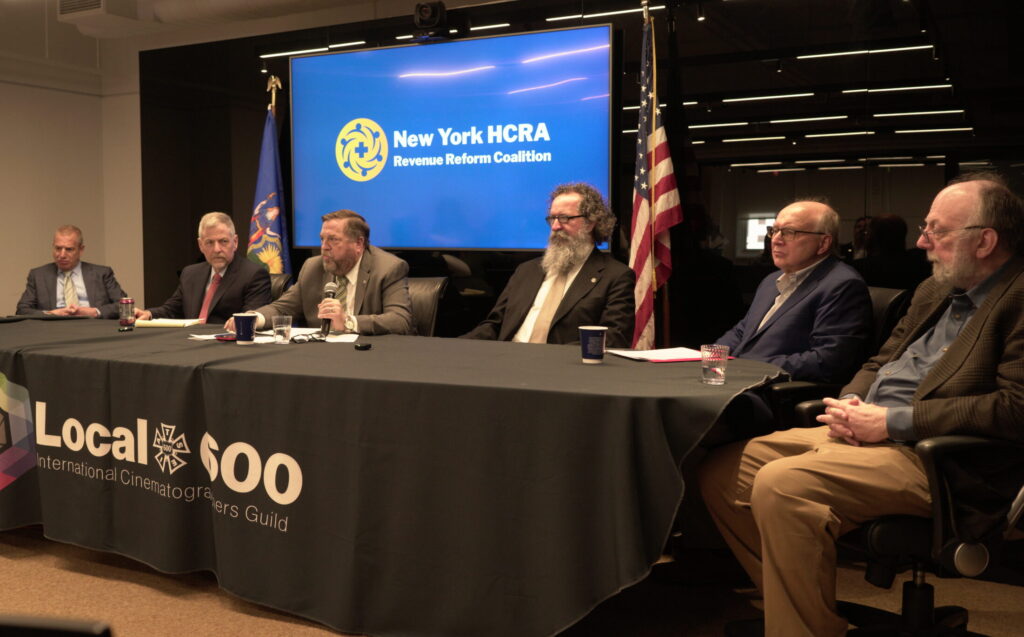
The HCRA Revenue Reform Coalition is a diverse group of labor unions and trade associations united in the fight for a fair and equitable tax system. These organizations represent hundreds of thousands of New York workers and responsible employers who are currently burdened by the flawed HCRA system.


























Media
- NY Times: Employer Health Costs Are Expected to Spike in 2027 (9/2/26)
- The Chief-Leader: Health insurance tax reform bill backed by large coalition of unions (3/25/26)
- Testimony: Mason Tenders’ District Council of Greater New York & Long Island, LIUNA (2/26/26)
- NY Daily News: Opinion: New York should expose employers using Medicaid (2/25/26)
- Times Union: Commentary: Health Care Reform Act hurts employers who are doing the right thing (7/1/25)
- PoliticoPRO: Labor coalition unites against state’s Health Care Reform Act (4/23/25)
Frequently Asked Questions (FAQs)
What is The Health Care Reform Act (HCRA) and why was it created?
The New York Health Care Reform Act (“HCRA” – prounounced “hick-ruh”) passed in 1996 and became effective January 1, 1997. HCRA was originally created to establish new revenue streams to collect funds for specific “public goods” such as Indigent Care (healthcare for those unable to pay) and Graduate Medical Education (“GME”, the training of doctors).
How does HCRA generate revenue for New York State?
HCRA primarily generates revenue through two mechanisms:
- Hospital Surcharge: These are taxes applied to most hospital, diagnostic treatment center, and ambulatory surgical center claims for services incurred in New York. Payers can elect to pay a 9.63% surcharge directly to the state or face much higher surcharges (up to 65.18% for inpatient care) if they don’t elect.
- Covered Lives Assessment (“CLA”): This is an annual flat tax assessed on health claim payers (like insurance companies and self-funded plans) based on the number of individuals they cover who reside in New York. Rates vary by region.
How much money does HCRA bring in annually?
HCRA taxes raise approximately $6.5 billion annually for New York State. It is the state’s fourth-largest revenue source.
What public programs are funded by HCRA?
Originally focused on Indigent Care and Graduate Medical Education (“GME”), HCRA now funds a broader range of programs, including: Doctors Across New York (“DANY”), Nurses Across New York (“NANY” ), the Diversity in Medicine Program, the Elderly Pharmacy Program, support for Home Care Workers in NYC, School Based Health Clinics, subsidies for Medical Malpractice Insurance, and a significant portion (approximately $5 billion) goes towards a Medicaid subsidy.
Who is most affected by HCRA taxes?
- Employers who provide health benefits (especially unionized employers)
- Their employees (who may see reduced wages or higher benefit costs), an
- Union health benefit funds
Ultimately, anyone with private health insurance in New York or receiving certain healthcare services within the state will bear some of the cost.
Why is the current HCRA revenue system considered so unfair or problematic?
- Inequity: It is a disproportionate burden on employers who provide health benefits, and their employees, while many employers (including large ones) who offer no or minimal benefits pay nothing into this specific tax pool. As a public policy, this effectively penalizes responsible behavior.
- Regressivity: HCRA taxes are unrelated to a consumer’s wealth or ability to pay, making them regressive.
- Lack of Transparency: The charges are often hidden within health insurance premiums or employer costs, so payors don’t see the direct impact.
- Diversion of Funds: A large portion of the money (about $5 billion of $6.5 billion) now subsidizes Medicaid, rather than being solely dedicated to the original “public goods” pools.
- Cost Impact: HCRA taxes add significant costs to health coverage, an approximate 4.3% increase before collective bargaining negotiations.
How much does HCRA cost me?
Based on 2024 data, HCRA taxes HCRA taxes add 8.1% to the average cost of health insurance in NYC, 6.1% on Long Island, and about 6% throughout the rest of New York. These taxes cost an estimated $2,300 for a family of four, annually.
What is the HCRA Revenue Reform Coalition and what are its goals?
The HCRA Revenue Reform Coalition is a group of stakeholders, including labor unions and trade associations, advocating for changes to the HCRA tax structure. Our main goals are to:
- Repeal the current HCRA taxes.
- Replace them with broad-based, equitable tax surcharges that ensure fair distribution of the tax burden among all employers.
- Transition funding sources in a revenue-neutral manner that preserves full funding for all current HCRA-supported public goods and avoids Medicaid cuts.
What are the main changes proposed in the HCRA revenue reform legislation?
The Coalition’s priority legislation, A.8642 (Hevesi)/S.8157 (Ramos), would:
- End the current hospital surcharge and covered lives assessment, effective April 1, 2026.
- Introduce new “Public Goods and Medicaid Subsidy” tax surcharges on insurance corporations, business corporations (with an exemption for small businesses), and pass-through entities; implement an LLC Filing Fee surcharge and a Misclassified Worker surcharge.
- Exempt public employers from these taxes (other than the State itself, which can opt to tax itself).
- These new taxes would become effective April 1, 2026, and expire March 31, 2029.
Will reform cut funding for public health programs?
NO!
The reform proposals are designed to be revenue-neutral. The aim is to change how these programs are funded, not to defund them.
The Coalition supports the essential programs funded with HCRA revenues. One of our primary goals is to preserve all funding in full for current HCRA-supported public goods and to ensure no Medicaid cuts result from the revenue reforms.
How would the proposed replacement taxes work? Who would pay them?
Replacement tax surcharges would be broad-based and levied on private sector businesses. The new taxes would phase in over a period of three years, so businesses would have the opportunity to plan for the changes in tax obligations.
Crucially, the proposal creates a “fair share” incentive with a lower surcharge rate for employers who provide qualifying health benefits, and a higher rate for those who do not. This flips the incentive the way it should be, by rewarding businesses who invest in health benefits for their workers.
How much will current HCRA payors save under the proposal?
After the three-year phasing in, private businesses who currently pay HCRA taxes will see their HCRA tax obligation reduced by approximately two thirds, or 66 percent.
Public sector employers who are not subject to business taxes will see their HCRA tax obligation eliminated entirely.
How are small business be affected by the proposed reforms?
The proposed “Public Goods Tax on Business Corporations” specifically exempts employers of fewer than fifty employees (or full-time equivalents) in a calendar year.
Within the construction trades, the small business threshold is instead gross revenue of less than $5 million annually.
What are the chances of HCRA reform succeeding?
Reforming HCRA is politically challenging: HCRA generates substantial revenue for the state, and there are entrenched interests that benefit from leaving the current revenue structure intact.
However, with a strong coalition and lobbying campaign, change is possible. We strongly believe the current HCRA revenue system cannot withstand the light of day.
HCRA taxes are extended triennially without discourse or controversy, and they are currently scheduled for sunset or renewal in 2026. Success will depend on building a strong, united coalition of unions, employers, and insurers, and on sustained advocacy to overcome decades of political inertia.